
Race report for the San Diego 100 Ultramarathon.
Course/Race statistics:
- Distance: 100.76 miles (Strava)
- Elevation Gain: 14,311 feet (Strava)
- Number of Finishers/Participants: 134/256
- Total time: 25:41:07
- Total moving time: 24:16:53
- Fastest mile (4): 10:05
- Slowest mile (45): 20:29
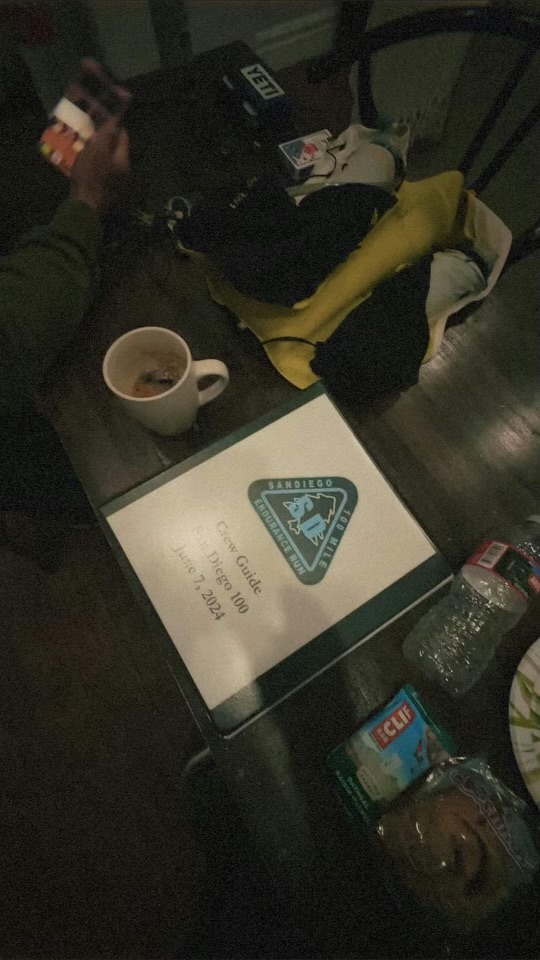
Pre-race: I slowly built up my running mileage throughout the spring. Most of my miles were at an easy, zone 2 aerobic effort. On the weekends, I always tried to get out on the trails for my long runs and stack back-to-back long runs on Saturday and Sunday. I incorporated a few workouts that I enjoyed where I would power hike up a climb and then run down hard. I focused on downhill running to build strength in my quads and joints. I ran six days a week and had a peak week in the mid-60s for total mileage. I played around a lot with different nutrition but mainly used a combination of Skratch and Tailwind for liquid supplements and GU energy gels, chews, blocks, etc. One new thing I emphasized was sauna training. For the three weeks leading up to the race, I went daily for 30-60 minutes (typically broken up into smaller sessions) to adapt my body to the heat.
Gear:
- Shoes: Hoka Mafate
- Watch: Coros Apex Pro 2
- Socks: 3x lightweight darn tough mid-calf
- Vest: Salomon Adv Skin 12
- Trekking poles: Leki
- Shirt: Columbia Omni Freeze
- Shorts: Vuori 7-inch inseam
- Sunglasses: Goodr
- Hat: Outdoor Research w/ shoulder/neck protection
- Anti-Chafe: Body glide (toes, feet, groin/thighs, arms/chest)

Miles 1-20:
Before the race, I told myself that my plan for at least the first 50 miles was to go aggressively slow. I wanted to feel uncomfortable with how slow I was going. I put myself in the middle of the field and knew that would be an ideal pace for the start. The energy at the beginning of the race was electric, and throughout the first few hours, most people ran in a solid group. I didn’t talk much, but it was nice to listen to the constant chatter, and it’s a rare opportunity for most of us when a few hundred people come together and can talk about nothing but running for hours. The first 20 miles went by relatively quickly and included three big climbs: Stonewall Peak, Middle Peak, and Cuyamaca Peak. I was surprised by the number of people who went out way too hot. I remember seeing people on the side of the trails on climbs gasping for breath and struggling when we were only 10-15 miles in. I am glad I took things slow and did not wreck my body in the first few hours. Eventually, I made it to the first crew station (earlier than planned, even with my slow pacing) and surprised one of my friends crewing as they weren’t expecting me. Luckily, I did not need any complex support that early in the race, but it was nice to see them, get some food and water, and be on my way.
Miles 21-40:
As the day progressed, the heat started to set in. I had done a lot in preparation, so I was ready for the heat, but I have never been comfortable with the sun beating me down. Cold > heat all day. This was also the most boring and least well-maintained section of the trail. I had run this section a few weeks prior, so I knew it well, which helped me to navigate and zone out through the trail monotony. I was also still with 3-4 other people. We would almost alternate when we would pass each other and when we would run together. It was a weird dance of when people felt good. I distinctly remember coming across a river crossing and one guy dunking his whole body in the stream. He jumped out, immediately touting the revitalizing powers of the cold brown stream water. While I refrained from total immersion to beat the heat, across the stream, I got a nice Icee-Pop on the other side from an aid station that tasted amazing. I also remember getting a few random texts from people during this section that were just standard run-of-the-mill questions or communications. Apologies to the people I did not respond to immediately (I eventually just turned my phone on airplane mode). Rolling into the crew station at mile 40 was a relief as I was very excited to see my people and have a pacer with me for the next section.

Miles 41-60:
I remember talking to a friend (a seasoned ultramarathoner, including SD100) during a training run through this section, and he told me that this would be the most challenging section of the race. I didn’t quite believe him then, but I was proven wrong on race day. While there was only one long climb, tons of small hills constantly sent the runners up and down, making finding a rhythm difficult. Additionally, this section was very technical as the trail was littered with big and small stones everywhere. It took a toll on my feet, and I lost track of how many times I stubbed my big toes into rocks. Every time that happened, I chastised myself for being lazy and dragging my feet. Lastly, this section took place during the late afternoon and offered minimal shade coverage on a day when the temperature out there got well into the 80s. I passed mile 50 in 11:37:00. During most of the first half of the race, I was obsessively doing calculations in my head of what splits I needed to run to go sub-24 hours on the day (if you run the race faster than 24 hours you get a special belt buckle. I wanted that buckle).
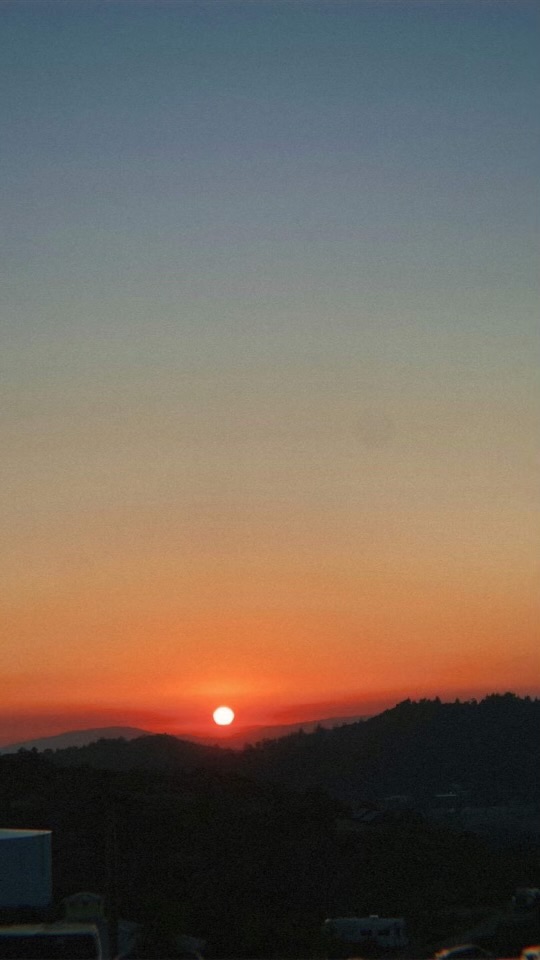
Miles 50-60 were especially brutal, and I remember thinking that if I felt as bad as I did for those miles for the rest of the race, I would be shattered as I crossed the finish line. It was also the most dissociative experience I have had while running. A combination of 12 hours of running at that point and dehydration contributed to the weird sensation of my mind and body untethering. Nonetheless, I maintained enough mental acuity to keep eating and drinking proactively in the hopes that, eventually, I would feel better. As I slowly marched through Noble Canyon with my brave and ever-encouraging pacer, I could feel the temperatures drop as the sun set. One important learning point was that I only made it to the next crew station with 10-15 minutes to spare before it got dark to a degree where a headlamp was necessary. I had not been carrying a headlamp, so while I timed it perfectly in practice, I left little room for error.
Miles 61-80:
The Nightman Cometh. I remember the sobering reality of traversing around 60 miles in 14 hours and realizing that I still had the whole night of running ahead of me. The first 5-10 miles were relatively flat. I felt like my legs and mind bounced back, and I was cruising along. Rejuvenated from the cool air, I clipped along steadily until around mile 70. At this point, I finally gave up on the sub-24 dream. It was a relief. I had been so focused on it for the previous day, and it felt great to let go of that pursuit and focus on getting to the next aid station and running smartly. “Running” consisted of around 12-minute miles on flat ground with walking breaks and walking every uphill.
The disorientation of the night threw me off a few times, and I was very grateful I had pacers with me. I was convinced we had gotten off track several times, and it felt like we were running in circles. However, I knew I was guided by experienced runners confident in telling me we were heading towards the still-so-far-away finish line. There were also more aid stations throughout the night. I gave up on gels and chews around miles 50-60 and resorted to a combination of tailwind, quesadillas, soup, and M&M’s. For the rest of the race, there was a subtle maraca-sounding chime with every step I took due to my pocket full of M&M’s. The other pocket was typically home to a half-eaten quesadilla. The aid stations were excellent, and it was sometimes bizarre to show up at midnight to a bright, multi-color lit tent with people in costumes full of energy catering to my every need and telling me to sit and eat. I am very grateful to everyone who volunteered; the experience was much more enjoyable due to their efforts and reckless energy. As tempting as it was to sit and bask in the warmth and care that the aid stations offered, one thing I know I did well throughout the race was to keep moving quickly through them. I got some food, caught my breath, joked around a bit, and got on the road as soon as possible. People spend an egregious amount of time getting comfortable at these aid stations. It is understandable and part of the experience; however, I was still trying to finish as fast as possible.
The only issue I had with my feet during the whole race also came about during this section and lasted until the end of the race. I started developing some slight irritation on the bottom of my outside ankle bone on my left foot. This was caused by rubbing against the outer lip of my shoe, which grew quite annoying over time. As it got more raw and painful, I kept trying to change my gait slightly to avoid the little shot of pain that I felt with every step. Eventually, I gave in to the feeling and figured it would not worsen over the next 20 miles. It was easier to deal with that slight irritation than constantly thinking about how to avoid it. On that note, “let go” became a pseudo-mantra or mental state I kept trying to get into. I was trying to fully separate the sensations in my body from how my mind was operating. I could let myself wander and think about whatever I wanted without being distracted by the qualms of my body.
Towards the end of this section, I felt exceptionally exhausted. Not in a physical sense (my legs were accepting their fatigue and were ready to keep rolling) but in a way where I just wanted to lay down on the trail and fall asleep instantly. Even talking got tricky as the mental strain of vocalizing my thoughts did not seem worth it. As my pacer kept talking and tried to keep my spirits up, I became less responsive and turned inwards. I knew I just needed to keep moving through the night, and eventually, the sun would come back up and infuse me with its vast solar energy.

Miles 81-100:
Similar to how people say a marathon is a 20-mile warm-up for a 6-mile race, I have heard multiple times that the actual 100-mile race starts at mile 80. So, with two caffeine pills and a new pacer, I ran mile 81 in 5 minutes flat with my eyes on the podium. Sike. Nothing changed physically. I kept about the same pace and continued moving forward steadily. As the sun rose, I was reminded of my failure to finish in 24 hours (finishing before dawn) but was also reenergized with the knowledge that I would be done soon. The last 20 miles were a net downhill on well-maintained trails, which felt like heaven for my tired legs and abused feet. It was a smooth ride to the end, and I believe I even got some sections in at around a 10-minute mile pace (a borderline all-out effort at this point). With the sun returning, I was grateful to finish before another brutal day of heat set in. To all those out there for another 8 hours, I commend you on your bravery in wrestling with that sun two days in a row.
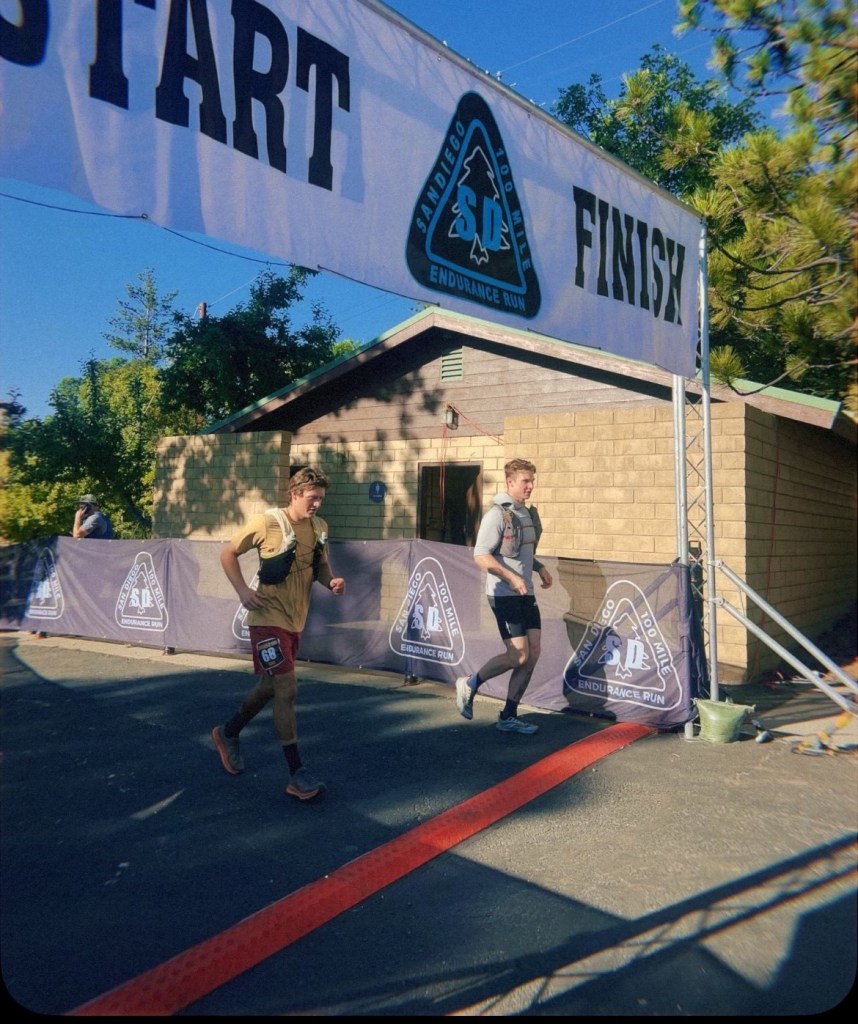
Crossing the finish line was a unique experience, and I was happy to see the race directors and another training partner waiting to give me my medal. More importantly, I was excited to sit down with my crew and pacers without more impending miles in my future. Relaxing in the relief of finishing is a blissful feeling made all the better by having friends out there with me.
I remember talking with my pacer about how I felt in the last few miles. I honestly felt pretty good. My legs were still moving, and I could still eat without any digestive issues. I was ready to be done, but that’s because I had been telling myself for months that 100 miles was the goal. Yet still, the small voice in the back of my mind whispered that I could keep going. If I needed to, I could. Maybe another day.
Key Takeaways:
What would I have done differently? The execution of the race went about as smoothly as I could hope for. My pacing and nutrition were spot on, and I never felt close to blowing up or my stomach giving out on me. What would have most directly improved my overall performance is simply more training. I will continue to keep growing my aerobic base, speed, and strength as I take on different adventures in the future.
Crew/Pacers: They made the whole experience joyful and adventurous. I would always want to do these events as part of a team. I am incredibly thankful for the people who came out to support me; barring the night of poor sleep, they also had a great time together. A good crew and pacers will save you hours in events like these and make the overall experience more worthwhile.
The severity of ups and downs: I had heard about this before, but this was my first time experiencing it so aggressively. As I mentioned above, sometimes I felt good, and sometimes I felt terrible. These mental shifts could swing from hour to hour. Ultra events are definitely unique in the rollercoaster of physical, mental, and emotional ups and downs.
Lastly, as far as running goes, I have never heard of anyone regretting signing up for a race. Push those fears down for enough time to sign up and commit. It will be worth it.


 Douglas Thoughts
Leave a comment