
I wrote the last sentence of this story first. But don’t skip ahead. It won’t make sense unless you understand the context below. It’s good, I promise.
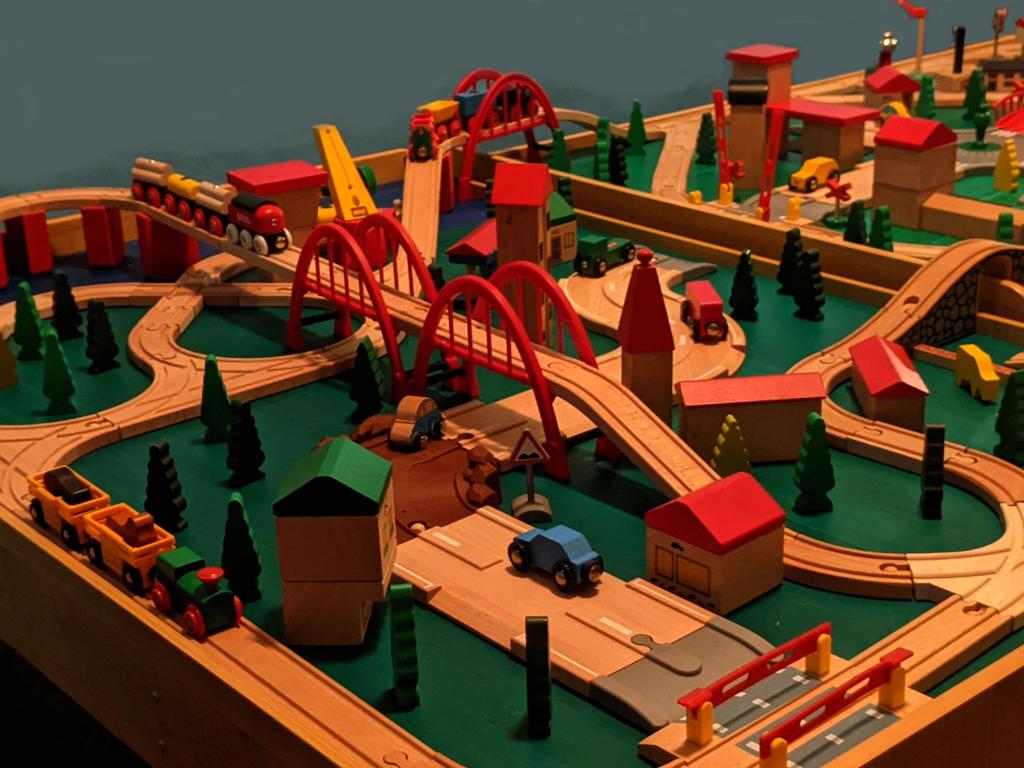
Like many of my peers, I spent my childhood as an ambitious and creative engineer. Some of my friends even grew up and went on to specialize in mechanical, electrical, or civil engineering. But back then, we all molded our physical world with the same tools. Legos. Lincoln logs. Wooden toy train tracks. While I dabbled with all three raw materials, I had a particular affinity for the train tracks. As a result, my family’s basement often transformed into a sprawling railway system with rollercoaster-esque drops and momentum-defying sharp turns. Imbued with the formidable power of sentience, I bore the responsibility of breathing life into my railway paradise. Each train had a purpose and a destination. Every Lego man on the side had a personality and a place to be. I spent hours building the complex network of train tracks as the backdrop for the ensuing rail drama that would follow. As childhood passions go, one day I packed up my train tracks into a big plastic bin, put them away, and never opened them again. While I romanticize that time now, I also know that my love of trains never disappeared; it merely evolved.
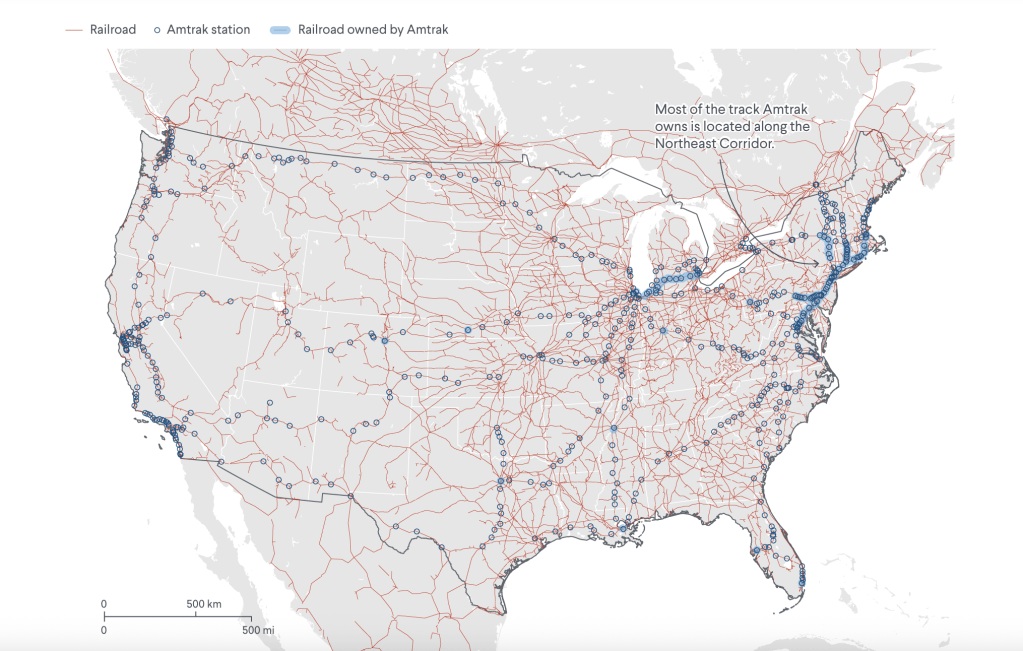
The United States has 140,000+ miles of railway. The railroad system in the United States is complex to say the least, but it is primarily owned and maintained by private freight railroad companies. These large freight shipping companies provide an essential national service as they transport goods throughout the country. Yet, there is debate about the dominance and prosperity of private freight shipping in the U.S. relative to our passenger rail system (government-funded Amtrak), which lags far behind in modernization, economic viability, and railroad jurisdiction. Fueled by the American culture of driving by car, the U.S. does not seem keen or eager to revolutionize our railroad model.
If you want to learn more about the U.S. railway system, this site gives a decent overview: https://www.cfr.org/backgrounder/how-us-rail-system-works.
I am setting the background here as a reminder to everyone that trains do, in fact, exist. Trains are important. Life in the United States would look dramatically different if trains did not exist. Often, though, we only think of trains as a nuisance that we have to wait for as we count endless freight cars. Let’s just pause and appreciate that trains are integral to our societal structure. Akin to the veins and arteries that course through our body, trains are a systemic, far-reaching transportation system unrivaled in efficiency, carbon footprint, and overall historical significance to U.S. history and development. I genuinely enjoy discussing the merits of trains and the railroad system, but for now, I want to return to my love of trains and how it takes shape as an adult.
So yes, I love riding the train if you haven’t guessed it. It is my favorite way to travel. We are blessed in the United States with abundant places to visit and natural beauty to explore. Unless we live in a highly urbanized and densely populated area with a train or subway system already in place, we are usually limited to flying or driving everywhere we go. Flying, admittedly the most efficient transportation over very long distances, frankly sucks. We get tightly packed together into a metal cylinder with wings. It is loud. There is no personal space. I am almost guaranteed to be cold at one point and sweating at another. People lose their humanity and any sense of kinship as TSA-Pre gives them an entitled superiority complex that lasts a mere twenty minutes. After a flight, I feel ill, tired, and in need of a shower. Flying is not a great experience in and of itself. But we all do it when needed, and it works well.
Driving, on the other hand, is a little more bearable. It can be nice to cruise along with some good tunes and go exactly from point A to point B. But then there is traffic. There are crashes. There is road rage. I can’t take in the scenery when I drive as I focus on the road. I can’t shake the feeling that driving is a waste of time. Add on gas prices and driving is often more expensive than flying or taking the train. Driving is not my favorite thing, and it is not something I look forward to.
So, in rejection of the duopoly of American transportation, I started taking the Amtrak train from San Diego to Los Angeles to visit my family. The train costs $35 and takes 3 hours guaranteed. The drive, while slightly cheaper depending on what car you drive, can often take many more hours, depending on how you time the traffic. The train is always consistent, always on time, and never gets lost. The train also offers stunning views of the Southern California beaches along the Pacific Ocean. At times, I am only 50 meters away from the water. I can spend the whole trip gazing out the window. I can read. I can nap. I can work. I can watch surfers paddle and rip and enjoy the rhythm of the waves. I can think my thoughts unobstructed.
I usually spend the whole train ride in this transportative bliss. However, another good thing about the train is that people are more inclined to have a friendly chat. Now, I am typically not much of a casual conversationalist, but there is something about the spirit of the train that encourages one to talk to one’s neighbor. My passenger mate on my most recent train ride was an older gentleman named Carl. Carl had a soft but quick speaking voice—the kind you really have to pay attention to if you want to hear. Upon sitting down, he immediately introduced himself and started asking me questions about who I was and where I was going. I noticed Carl wearing a USC hat with a full USC jumpsuit as we talked. Keying in on this subtle ensemble of school flair, I deduced that he may be a USC sports fan, so I started asking him questions in kind. This opened up a two-hour conversation where I was not only briefed on the current state of affairs of all major USC sports programs but also got an updated history of most major professional and collegiate sports teams across the country over the past 40 years. Carl, the California native, would tell me all about the Minnesota Vikings’ current roster before quickly transitioning to describing the competitiveness of California Softball programs in the 90s. He was a walking almanac of all things sports.
Now, at this point in my life, I do not care much about sports. But something about the magic of the train had me thoroughly intrigued with things like NCAA conference dynamics and rivalries. Perhaps more importantly, the train provided an eager listener (me) for USC jumpsuit-wearing Carl to whom he could share his encyclopedic knowledge of sport. The travel flew by as the train smoothly and efficiently transported me where I intended to go. The times are rare when I reflect on my decision to ride the train and regret that choice. The train always proves a practical form of transportation while also providing an exceptional opportunity for new stories and experiences.
I look back now on opportunities where I have taken the erroneously perceived easier route and flown or driven instead of taking the train. I was recently in South Korea, and one of the most startling things about my visit was the breathtaking mountainous landscape. You can travel across the country in only a few hours, but the region is densely dominated by snow-covered peaks everywhere you look. South Korea also has a decent train system that takes one on a winding exploration throughout the country. The train offers an opportunity for views and experiences that would be impossible to achieve without the rail system.
I regrettably found myself at the airport one day, waiting to fly across the country. I was grabbing a quick soju drink before my flight. Soju is a common alcoholic drink in Korea, traditionally distilled from rice and very popular under the brand “Chuga”. As I looked out at the airport windows, it was hard not to be mesmerized by the distant peaks, safe and untouched by human industry. My reverie ended when my friend interrupted my contemplation and told me to finish my drink quickly and that we had to get moving. We needed to board our flight.

So it is from my own experiences that I leave this piece of wisdom and advice:
If you are ever in Korea, ride the rail and explore the mountains. Don’t chug a Chuga soju before your flight; instead, get on a train, pump your fist up and down, and chuga chuga choo choo.

 Douglas Thoughts
Leave a comment