A quick note. This message is for those who want to subscribe and receive an email notification with a link to my posts. There is a link on the bottom right of your screen that says “Subscribe”. Click it, add your email, and start aggressively clicking the refresh button in anticipation of the next post!
Last weekend, I drove from San Diego to Auburn to spectate and cheer for one of my favorite annual athletic events, the Western States 100. The Western States 100 is the oldest, most competitive, and most renowned ultra-endurance event in North America. Every year, athletes journey through an extensive qualifying process just to enter the race. On the professional side, athletes must first achieve a top 3 finish at select ultra races called “Golden Ticket” races. The Golden Ticket races are CCC (France, Italy, Switzerland), Black Canyon 100K (Arizona), Canyons Endurance Runs 100K (California), Tarawera 100K (New Zealand), and Chianti Ultra Trail 120K (Italy). All these races have grown extremely competitive in their own right as professionals compete for a coveted Golden Ticket and automatic entry into Western States 100. On the amateur side, athletes must complete a qualifying event before they can submit their application to the lottery. From there, a runner’s chances of entry into the race increases with your number of previous application attempts. In the 2024 cycle, 9,388 people applied for 270 spots. I talked to some people at the race who had applied for over five years consecutively with no luck. I also have a running friend in San Diego who got into the race with his first applciation. So it goes. Nonetheless, for those in the ultra-community, Western States 100 is a historic event where people from around the world come to celebrate the beauty of the sport.
Western States is known as the oldest official 100-mile race in the country. The race originated as a horseback race called the Tevis Cup in 1955. In 1974, or 52 years ago, Gordy Ansleigh, decided to get off his horse and run the entire distance in under 24-hours. For a more thorough history: https://www.wser.org/how-it-all-began/. It is quite remarkable to think about how much has changed in the race since that first year. The completion rate that year for Gordy was 100%, 1/1. Most years now finish with a 75% completion rate out of the ~370 runners. I imagine Gordy ran most of that race alone, except for some small towns he may have cruised through. Contrast that today, where aid stations are meticulously managed and decorated with sponsors, thousands of spectators show up to cheer, and individuals train for these races obsessively. Ol’ Gordy just stomped it out one day.

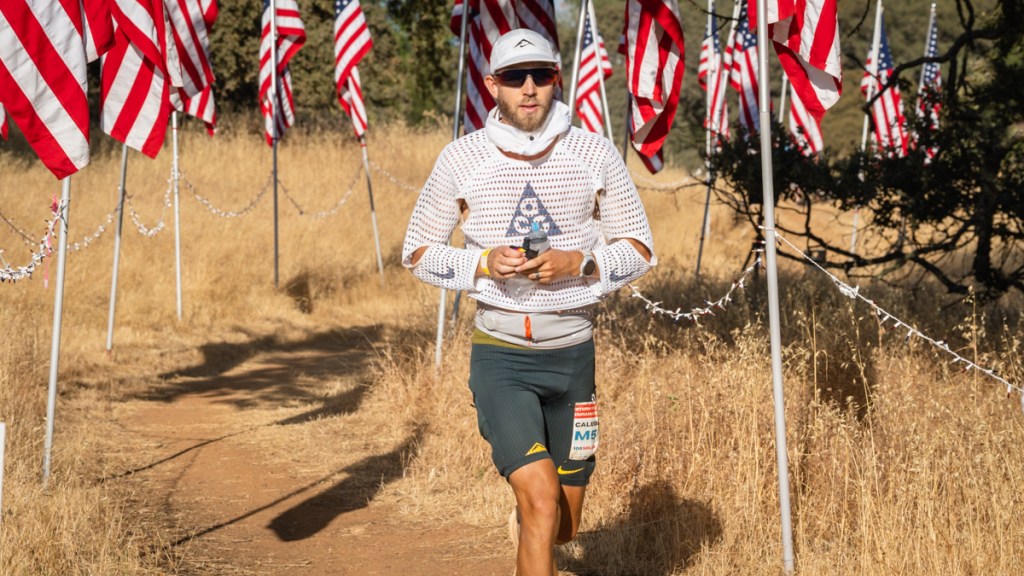
Let’s go through some stats. The Western States 100 is technically a 100.2 mile point–to-point foot race starting in Olympic Valley, CA (near Tahoe) and ending in Auburn, CA. The course contains 18,000 feet of elevation gain and 23,000 feet of elevation loss. These numbers are difficult to conceptualize even if you have spent significant time in the mountains. According to a quick google search, a flight of stairs is about 10 feet. So overt the course of the 100 mile journey, runners will also run up 1,800 flights of stairs and down 2,300. Western States is also notoriously hot. This year the high reached 99oF. This is brutal and there is no real way around it. However, runners implement many techniques to combat the effects of heat on race day. Some are preparatory and used in training prior to the race. These include sauna, training in heat controlled rooms, and training purposefully in the hottest part of the day. On race day, heat dampening techniques include ice bandanas (essentially an ice block sitting on your neck), proper hydration, jumping in streams and rivers during the race, Super Bowl Champion Coach ice bucket sloshings, and even breathtaking new fashion technology (see below). One of the rewards for running through the mountains and heat is a spectacularly unique perspective on nature. Western States 100 is a trail race that passes through some absolutely stunning terrain from the high country mountains to the golden river canyons. While there are plenty of pictures from race day, I bet the most stunning views stay hidden in the private memories of everyone running.
One of the more memorable moments for me as a spectator came early, Saturday morning. I was in Auburn and about to drive up to Forest Hill to go to the first aid station where I would watch the runners come through. Before heading up, I decided to go check out the finish line in Auburn while it was still quiet. The race finishes on the track at Placer High School. When I arrived, there were only about 20 people setting up stuff for the finish. I found a spot to sit while I listened to the live broadcast of the race. For those who also followed the live broadcast, at this point I could actually hear Dylan Bowman and Corrine Malcolm in person as I was right behind the studio on some bleachers. What happened next though shocked me and is a moment I will never forget. As I am sitting, a man walks out of the studio and starts walking up the bleachers. I immediately recognize him. That’s Jim Walmsley.

For those who don’t know, Jim is potentially the greatest ultramarathon runner of all time. He is also the course record holder at Western States but did not run this year due to injury. To say I have followed Jim closely for years is an understatement. If he has been on a podcast, I have heard it. If there is a documentary on youtube about him, I have watched it. It was the most starstruck I have ever been in my life. So, as he walked up the bleachers in my direction my internal conversation went something like this: “Oh my god, that’s Jim. I gotta say hello. Just shake his hand. Be cool. He is just another person. Just say hello quick.” I pulled myself together and we ended up having a quick and normal exchange. I expressed how I am a longtime fan and supporter and just wanted to say hello. He was kind and graceful. It is definitely an odd dynamic where I know so much about him and I just say, “Hey, my name is Luke”, and that is all he knows about me. I am not exaggerating when I say if there was any person in the world who I could meet he would be at or near the top of the list. It was a special moment for me. Also, now I can never wash my right hand. Maybe some of Jim’s running prowess will slowly seep into my legs. That quick exchange alone made the trip worth it.
The rest of the race was amazing to watch. The publically accessible aid stations absolutely exploded with energy when the runners came through. Cheering the top men and women run reminded me of watching the Tour de France where the spectators form a tight channel for the bikers to pass through. All while screaming encouragement as loud as possible. Watching Killian Jornet storm by with his European entourage was surreal.
For the finish, all the spectators made their way to Placer High School. There were thousands of people on the track and in the bleachers waiting for the first runners appear. Runners entered the track from the street and ran ¾ of a lap to the finish. In anticipation of the first runners, I took my place right near the track entrance. Before the eventual winner, Caleb Olson, even made it to the track I could hear the cheers and screams down the street as people willed him forward to the finish line. Once he hit the track, the whole stadium erupted in cheers as he took his victory lap with his crew. Right after he passed me on the track, I turned around and ran across the field in the middle of the track to try and find an unoccupied spot at the finish to see him cross (I was unsuccessful, the place was packed). Hundreds of other people had the same idea, we all turned and stampeded across the field towards the finish line. Some good mob energy. The same atmosphere persisted for all the top runners, especially Abby Hall, who finished first for the women.
The finish line of a 100-mile race is an emotional and unique place. Runners collapse, cry, scream, laugh, and most importantly, bask in the relief of a chair without having to rise again. But everyone who sets out on this kind of journey has a different story. From Caleb Olson, who ran the race in 14 hours and 11 minutes, to the people who finish in the “Golden Hour” zone of 29-30 hours. It was truly amazing to be at the finish line for all the finishers I got to witness and cheer home. Another wild experience: I went to bed on Saturday night around 11:00pm while there were still people finishing. I woke up around 7:00am, walked up to the track and immediately started cheering and clapping again as people were still arriving and doing their final ¾ track lap to finish up their race.
Ultramarathons are an incredible adventure as a participant, crew member, or spectator. There are few other endeavors in life that combine suffering, peace, pain, problem-solving, and joy like an Ultra. There is no hiding in an Ultra. They are raw tests of who we are. And for whatever reason, they are pretty darn fun.

 Douglas Thoughts
Leave a comment